Evaluation of PLA and PETG filaments for the addition of hydroxyapatite in 3D-printed dental models
DOI:
https://doi.org/10.17488/RMIB.47.2.1618Keywords:
filaments, hydroxyapatite, 3D printing, PLA, PETGAbstract
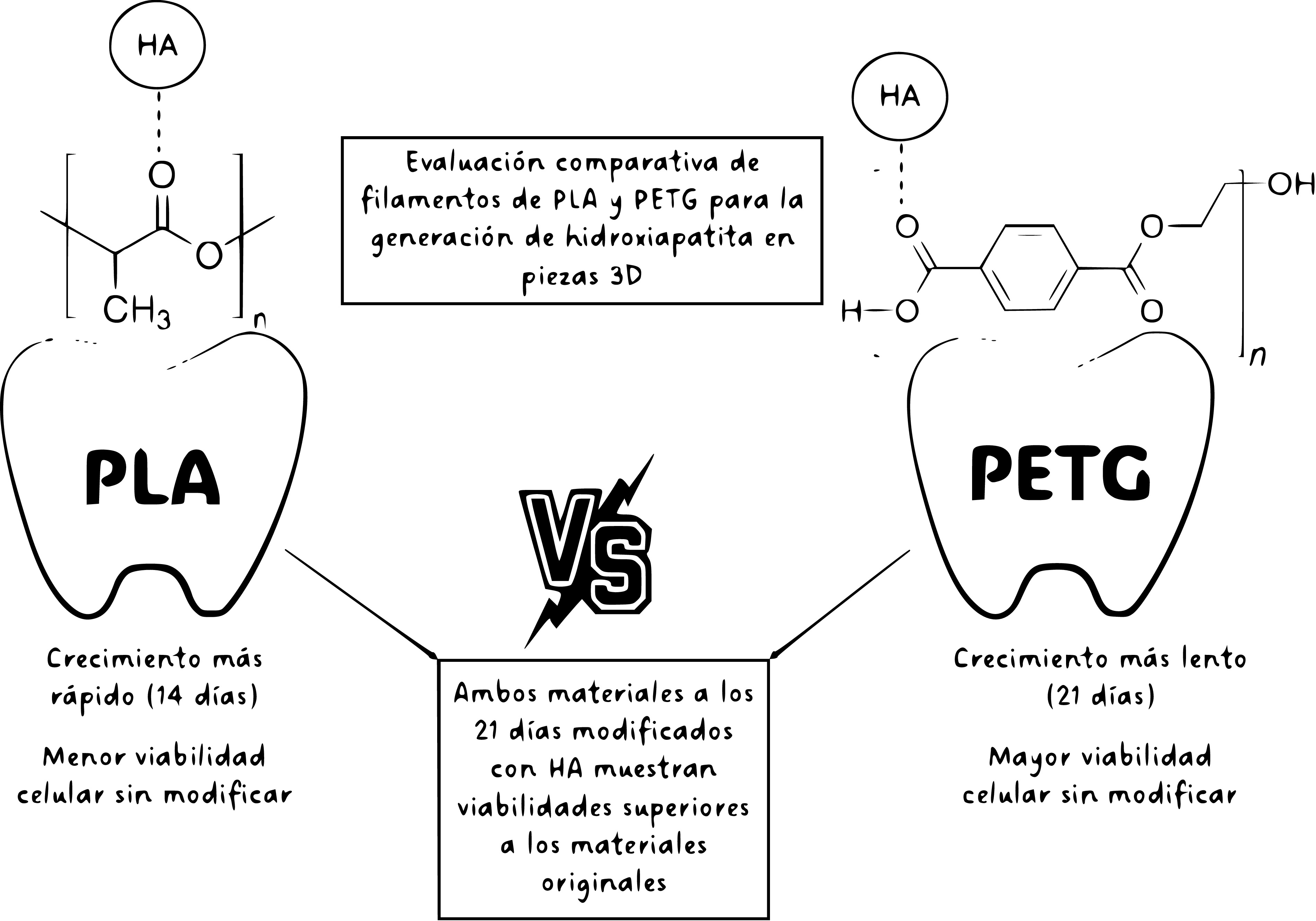
Additive manufacturing has established itself as a key technology in dentistry, enabling the manufacture of customized devices with precision and in reduced times. Among the most widely used filaments are polylactic acid (PLA) and glycol-modified polyethylene terephthalate (PETG), both with different properties that influence clinical performance. This study presents a comparative evaluation of PLA and PETG filaments in the generation of hydroxyapatite on 3D-printed pieces through hydrothermal treatment in simulated body fluid (SBF) solution. Dental models were printed with PLA and PETG filaments under controlled conditions and immersed in SBF for 7, 14, and 21 days. Modified pieces were characterized by infrared spectroscopy (IR-TF), X-ray diffraction (XRD), and scanning electron microscopy (SEM) to evaluate surface modifications and mineral formation. The results showed that PLA, due to its greater porosity and roughness, favored early hydroxyapatite nucleation, presenting a stable layer at 21 days. PETG showed slow nucleation, but at 21 days it showed characteristic hydroxyapatite agglomerates. Cytotoxicity tests with 3T3 fibroblasts confirmed that both materials maintained cell viability above 70%.
Downloads
References
U. T. Str¨ahle, N. P¨utz, and M. Hannig, “A coating machine for coating filaments with bioactive nanomaterials
for extrusion 3D printing,” Heliyon, vol. 10, no. 12, p. e33223, Jun. 2024, doi: https://doi.org/10.1016/j.heliyon.2024.e33223
A. J. R. Barcena, P. Ravi, S. Kundu, and K. Tappa, “Emerging Biomedical and Clinical Applications of 3DPrinted
Poly(Lactic Acid)-Based Devices and Delivery Systems,” Bioengineering, vol. 11, no. 7, art. no. 705, Jul. 2024, doi: https://doi.org/10.3390/bioengineering11070705
G. Iosub et al., “New Three Dimensional-Printed Polyethylene Terephthalate Glycol Liners for Hip Joint
Endoprostheses: A Bioactive Platform for Bone Regeneration,” Materials, vol. 18, no. 6, art. no. 1206, Mar.
, doi: https://doi.org/10.3390/ma18061206
E. H. Backes et al., “Fabrication of Biocompatible Composites of Poly(lactic acid)/Hydroxyapatite Envisioning
Medical Applications,” Polymer Engineering & Science, vol. 60, no. 3, pp. 636–644, Jan. 2020, doi: https://doi.org/10.1002/pen.25322
R. F. Martins et al., “Mechanical Properties of Additively Manufactured Polymeric Materials—PLA and
PETG—For Biomechanical Applications,” Polymers, vol. 16, no. 13, art. no. 1868, Jun. 2024, doi: https://doi.org/10.3390/polym16131868
S. Y. Shilov et al., “Biocompatibility of 3D-Printed PLA, PEEK and PETG: Adhesion of Bone Marrow and
Peritoneal Lavage Cells,” Polymers, vol. 14, no. 19, art. no. 3958, Sep. 2022, doi: https://doi.org/10.3390/polym14193958
C. E. Corcione et al., “3D printing of hydroxyapatite polymer-based composites for bone tissue engineering,”
Journal of Polymer Engineering, vol. 37, no. 8, pp. 741–746, Oct. 2017, doi: https://doi.org/10.1515/polyeng-2016-0194
C. A. Orozco-D´ıaz et al., “Characterization of a composite polylactic acid-hydroxyapatite 3D-printing filament
for bone-regeneration,” Biomedical Physics & Engineering Express, vol. 6, no. 2, art. no. 025007, Feb. 2020,
doi: https://doi.org/10.1088/2057-1976/ab73f8
D. Tich´a et al., “Three-Dimensionally-Printed Polymer and Composite Materials for Dental Applications with
Focus on Orthodontics,” Polymers, vol. 16, no. 22, art. no. 3151, Nov. 2024, doi: https://doi.org/10.3390/polym16223151
M. Kohan et al., “Analysis of PLA/PHB Biopolymer Material with Admixture of Hydroxyapatite and Tricalcium
Phosphate for Clinical Use,” Polymers, vol. 14, no. 24, art. no. 5357, Dec. 2022, doi: https://doi.org/10.3390/polym14245357
T. Kokubo and H. Takadama, “How useful is SBF in predicting in vivo bone bioactivity,” Biomaterials, vol. 27,
no. 15, pp. 2907–2915, May 2006, doi: https://doi.org/10.1016/j.biomaterials.2006.01.017
A. L. dos Santos et al., “Development and Characterization of 3D-Printed PLA/EG Composite Filaments,”
Polymers, vol. 16, no. 22, art. no. 3131, 2024, doi: https://doi.org/10.3390/polym16223131
Y. Perez-Davila, F. M. L. Castro, C. A. F. Iglesias, J. M. L. Dapena, and M. J. S. Alvarez, “3D-Printed PLA
Medical Devices: Physicochemical Changes and Biological Response after Sterilisation Treatments,” Polymers,
vol. 14, no. 19, art. no. 4025, 2022, doi: https://doi.org/10.3390/polym14194117
T. R. Maia-Pinto, F. F. Souza, T. A. Lima et al., “Biomimetic Mineralization on 3D Printed PLA Scaffolds: A
Promising Approach for Bone Tissue Engineering,” Materials, vol. 13, no. 24, p. 5656, 2020, doi: https://doi.org/10.3390/polym13010074
B. S. Kim, J. S. Kim, H. J. Chung et al., “Effect of Morphological Characteristics and Biomineralization of
D-Printed Gelatin/Hyaluronic Acid/Hydroxyapatite Composite Scaffolds,” International Journal of Molecular
Sciences, vol. 22, no. 13, art. no. 6794, 2021, doi: https://doi.org/10.3390/ijms22136794
A. Slosarczyk, Z. Paszkiewicz, and C. Paluszkiewicz, “FTIR and XRD evaluation of carbonated hydroxyapatite
powders synthesized by wet methods,” Journal of Molecular Structure, vols. 744–747, pp. 657–661, Mar. 2005,
doi: https://doi.org/10.1016/j.molstruc.2004.11.078
E. Daskalakis et al., “3D-printed PETG/BC for bone tissue repair,” International Journal of Bioprinting, Online
First, 2025, doi: https://doi.org/10.36922/IJB025210212
R. N. Darie-Nita, M. Rapa, and S. Frackowiak, “Special Features of Polyester-Based Materials for Medical Applications,” Polymers, vol. 14, no. 5, art. no. 951, Feb. 2022, doi: https://doi.org/10.3390/polym14050951
J. A. Rodriguez-Nanez, E. M. Muzquiz-Ramos, J. C. Rios-Hurtado et al., “Bioactive glass from eggshells
and silica oxide obtained by mechanical milling: Characterization and bioactivity tests,” Silicon, vol. 17, pp.
–2478, 2025, doi: https://doi.org/10.1007/s12633-025-03364-x
J. Chakraborty, S. Roy, and S. Ghosh, “3D printed hydroxyapatite promotes congruent bone ingrowth in
rat load bearing defects,” Biomedical Materials, vol. 17, no. 3, Apr. 2022, doi: https://doi.org/10.1088/1748-605X/ac6471
A. Farahani, A. Zarei-Hanzaki, H. R. Abedi, L. Tayebi, and E. Mostafavi, “Polylactic acid piezo-biopolymers: Chemistry, structural evolution, fabrication methods, and tissue engineering applications,” Journal of Functional
Biomaterials, vol. 12, no. 4, art. no. 71, 2021, doi: https://doi.org/10.3390/jfb12040071
B. Flora et al., “Development of chemically synthesized hydroxyapatite composite with reduced graphene
oxide for enhanced mechanical properties,” Journal of the Mechanical Behavior of Biomedical Materials, vol.
, art. no. 105845, pp. 1–10, Jun. 2023, doi: https://doi.org/10.1016/j.jmbbm.2023.105845
S. Soleymani and S. M. Naghib, “3D and 4D printing hydroxyapatite-based scaffolds for bone tissue engineering
and regeneration,” Heliyon, vol. 9, no. 9, e19363, Aug. 2023, doi: https://doi.org/10.1016/j.heliyon.2023.e19363
J. K. Abifarin, D. O. Obada, E. T. Dauda, and D. Dodoo-Arhin, “Experimental data on the characterization
of hydroxyapatite synthesized from biowastes,” Data in Brief, vol. 26, art. no. 104485, Sep. 2019, doi: https://doi.org/10.1016/j.dib.2019.104485
F. Alvarez-Carrasco et al., “Development of Bioactive Hybrid PLA/PMMA Electrospun Fibers Functionalized
with Bioglass Nanoparticles,” International Journal of Molecular Sciences, vol. 25, no. 13, art. no. 6843, 2024,
doi: https://doi.org/10.3390/ijms25136843
X. Wu, K. Walsh, B. L. Hoff, and G. Camci-Unal, “Mineralization of Biomaterials for Bone Tissue
Engineering,” Bioengineering, vol. 7, no. 4, art. no. 132, Oct. 2020, doi: https://doi.org/10.3390/bioengineering7040132
E. De Leon, A. P. Teske, B. Pais, and G. Grazioli, “Efecto de la intensidad de las unidades de fotopolimerizacion
sobre la biocompatibilidad y resistencia a la flexion de una resina compuesta,” Odontoestomatologia, vol. 24,
no. 40, e222, Dec. 2022, doi: https://doi.org/10.22592/ode2022n40e222
M. Olam and N. Tosun, “3D-printed polylactide/hydroxyapatite/titania composite filaments,” Materials
Chemistry and Physics, vol. 276, art. no. 125267, 2022, doi: https://doi.org/10.1016/j.matchemphys.2021.125267
Downloads
Published
How to Cite
Issue
Section
License
Copyright (c) 2026 Revista Mexicana de Ingenieria Biomedica

This work is licensed under a Creative Commons Attribution-NonCommercial 4.0 International License.
Upon acceptance of an article in the RMIB, corresponding authors will be asked to fulfill and sign the copyright and the journal publishing agreement, which will allow the RMIB authorization to publish this document in any media without limitations and without any cost. Authors may reuse parts of the paper in other documents and reproduce part or all of it for their personal use as long as a bibliographic reference is made to the RMIB. However written permission of the Publisher is required for resale or distribution outside the corresponding author institution and for all other derivative works, including compilations and translations.